
Cottonwood County Bench Warrants Explained
A bench warrant is the court policing its own orders against someone already in a case. The person missed a date, skipped a fine, let a payment plan lapse, or ignored a condition the judge set. That is the usual Cottonwood County pattern. The judge signs the order. The sheriff carries it out. The vocabulary shifts across state lines. Minnesota papers say warrant, bench warrant, arrest warrant, and Sign and Release Warrant. Some states use capias for a court order to take a person into custody. That word appears on no Cottonwood County document.
Cottonwood Missed Dates and FTA Warrants
Traffic tickets and criminal charges follow the same track. A summons or citation sets the date. The date comes and the person is absent. The court then reviews the file, and a warrant follows unless the matter qualifies for Sign and Release. The sequence stays short. File the case, miss the date, the judge reviews, the warrant issues. After that the case simply waits until the person appears or the court withdraws the warrant. The docket in Minnesota Court Records Online is the only public place these Cottonwood County steps appear.
Note: a warrant on the docket may take time to reach the sheriff's list, so the two sources can disagree briefly.
How Cottonwood County Bench Warrants Are Issued
Minnesota criminal procedure has a standard form. Form 8 is the application and warrant used after someone fails to appear on a summons or citation. It carries the court and county, the parties, the file number, the citation dates, the prosecutor, the charge, and the probable-cause basis. The judge signs it. The warrant then enters the court record and the Cottonwood County enforcement picture. It stays open until the person appears, the court recalls it, or it is quashed. Time alone closes nothing.
Cottonwood Sign and Release Warrants
Cottonwood County follows a change Minnesota made on January 1, 2024. Under Minn. Stat. § 629.415, the court issues a Sign and Release Warrant for a qualifying first failure to appear in a misdemeanor or gross misdemeanor case. The conditions are specific. The offense must qualify. The mailed summons must have come back undeliverable. The person must have failed to appear, and the case must hold no earlier failure to appear. That warrant does not authorize an arrest. When an officer makes contact in Cottonwood County, the officer takes an updated address, completes the form, hands over a new court date, and releases the person. A prosecutor can still seek booking or bail by showing a preponderance that release would endanger someone or the person themselves. Excluded offenses never qualify.
Key Point: Sign and Release is not amnesty. The case continues, the new date is mandatory, and an arrest is still possible in cases outside the rule.
Do not assume every Cottonwood bench warrant qualifies. Ask the court whether the statute applies to this case before you plan around it.
Bench Warrants and Arrest Warrants Compared
They look alike on a list. In practice they differ. A bench warrant enforces an obligation in a case already open in Cottonwood County, while an arrest warrant opens the door to custody on a charge. A person with a bench warrant may resolve things without being booked; a person with an arrest warrant usually cannot.
| Feature | Bench Warrant | Arrest Warrant |
|---|---|---|
| Trigger | A missed date or missed obligation in an existing case | Probable cause that an offense occurred |
| Who issues it | The judge handling the case | A judge or judicial officer on a charging document |
| Underlying case | Already open; the person knew about it | New or newly charged conduct |
| How it clears | Appear, recall, quash or Sign and Release | Surrender, bond or a court appearance |
The Cottonwood County arrest warrant search page covers the charge-based version in more detail.
Cottonwood First FTA Versus Repeat FTA
Whether this is the first missed date matters most. It decides how the warrant behaves. A first failure to appear in a qualifying misdemeanor or gross misdemeanor case can go through Sign and Release: updated contact information and a new court date instead of an arrest. A repeat failure in the same case falls outside the rule. So does a first failure on an excluded charge. Any case with a safety finding is excluded too. There the warrant behaves conventionally in Cottonwood County, meaning you appear, possibly post bail, and talk to a lawyer first. The file shows whether an earlier failure exists, and that record decides the path.
Resolving a Cottonwood County Bench Warrant
Order matters here. One wrong move turns paperwork into custody. Confirm the Cottonwood County bench warrant, find the issuing court, and ask what that court expects before you walk in.
- Confirm the warrant and the court that issued it, using the district court file number.
- Call Cottonwood Court Administration at (507) 831-7003 and ask what the next available date is and whether the court wants a filed motion.
- Ask whether Sign and Release applies, or whether bail or booking is likely instead.
- Talk to an attorney about a motion to recall or quash before you appear.
- Keep the written confirmation, new date or signed release form after the hearing.
Caution: A bench warrant does not expire and does not improve with time. It can be served at a traffic stop or any police contact, so resolving it early is usually the cheaper path.
No Separate Cottonwood Municipal Bench Warrant Court
Some states push ordinance and traffic cases into city or justice courts that issue their own bench warrants. Minnesota takes a different route. Cottonwood County has no municipal criminal court, no justice court, no city marshal's office, and no municipal bench-warrant docket. The district court page states that criminal and traffic cases filed in the county belong to it. The effect is simple. Police in Windom, Mountain Lake, and Westbrook write citations. Those citations travel to the district court in Windom. Any warrant that follows comes from there. A city website is not where a Cottonwood County bench warrant lives.
Finding the Court That Issued the Warrant
One court controls the recall, and here that is Cottonwood County District Court in the Fifth Judicial District. The courthouse stands at 900 Third Avenue in Windom. Doors stay open weekdays from 8:00 a.m. to 4:30 p.m. Court Administration answers at (507) 831-7003, where staff keep the file, the calendar and the copy counter for any Cottonwood County bench warrant question.
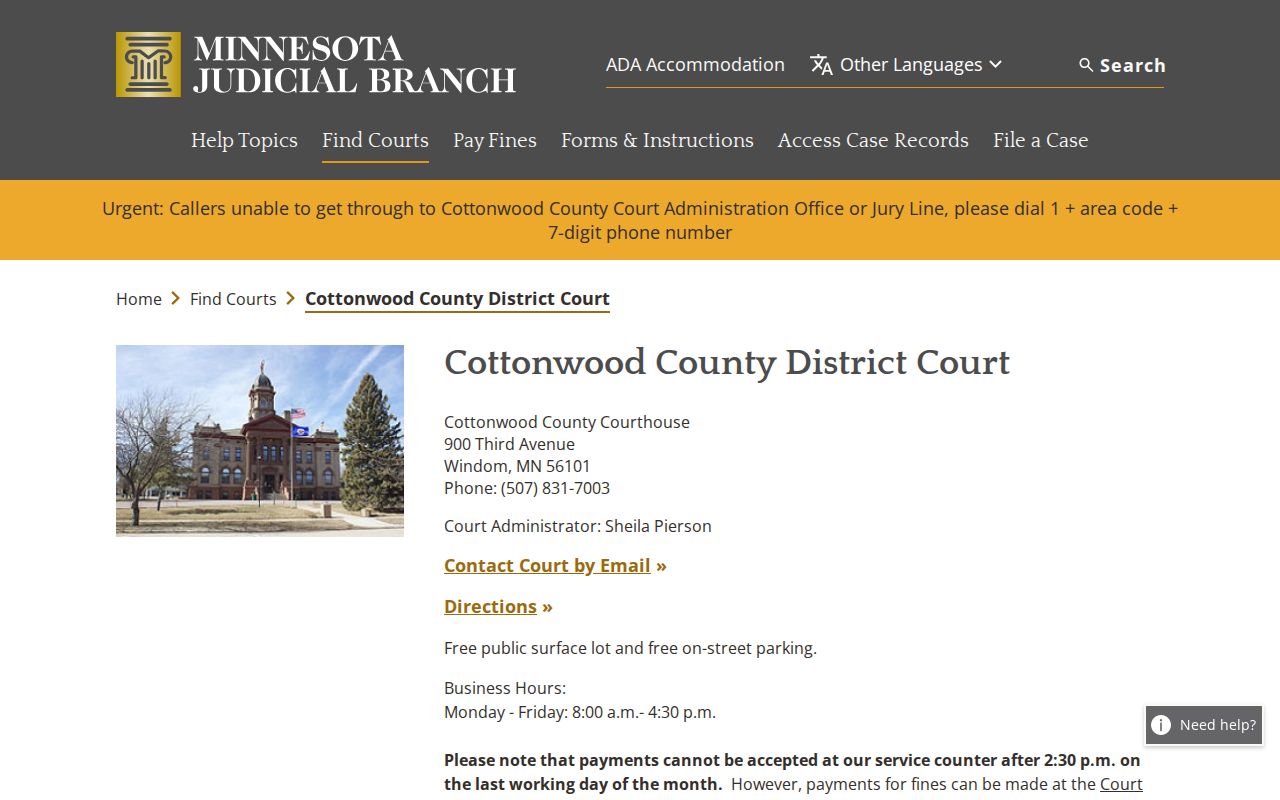 The court publishes its schedule and jurisdiction on its court page, and the weekly calendar is posted by 7:00 a.m. each business day and updated hourly.
The calendar leaves gaps. Some matters are omitted, and confidential cases never appear, so a missing entry does not cancel a hearing. For the most current version, check the printed calendars in the Cottonwood County courthouse lobby and let the clerk confirm your hearing date.
What Cottonwood Form 8 Warrants Show
Form 8 lays out what a bench warrant record can hold. Reading it shows why the Cottonwood County sheriff's four-field list feels thin.
| Court and County | The district court and judicial district, plus the county where the case sits. |
|---|---|
| Parties | The plaintiff and defendant labels used on the charging documents. |
| File Number | The district court file number, for example 2025-CR-000123. |
| Dates | The application date and the citation or summons dates that set up the missed appearance. |
| Charge | The offense and the probable-cause basis behind it. |
| Directed Officer | The sheriff or other authorized person the warrant is issued to. |
| Release Conditions and Bail | Any conditions of release and the amount of bail set by the court. |
| Return Information | Who issued the warrant and the fields completed when it is served. |
The blank form is published in the state court rules at revisor.mn.gov.  The sheriff's forms page carries civil writs and permits rather than a warrant-clearance form, which is why resolution starts with the court.